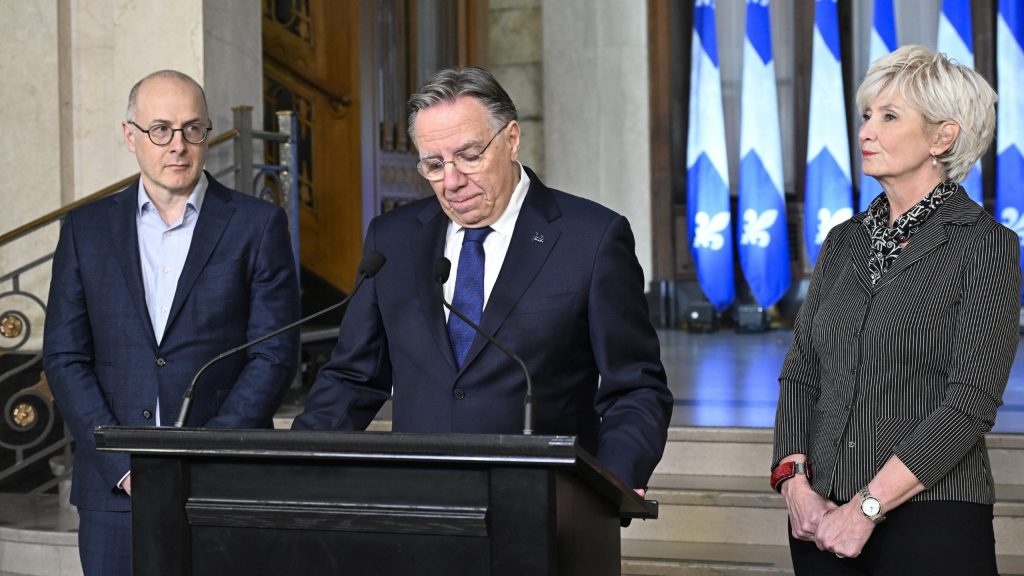
François Legault announced Wednesday he will step down as premier of Quebec, a move intended to reinfuse life in the struggling party just nine months away from an election.
Legault will remain premier and leader of the Coalition Avenir Québec (CAQ) until a new party leader is selected.
The 68-year-old, who repeatedly affirmed in recent months he would lead the CAQ in the next election, conceded Wednesday he recognized Quebecers were hungry for change, and that he decided to step down “for the good” of his party and the province.
A December poll found nearly three-quarters of Quebecers believed Legault should step down before or at the end of his mandate.
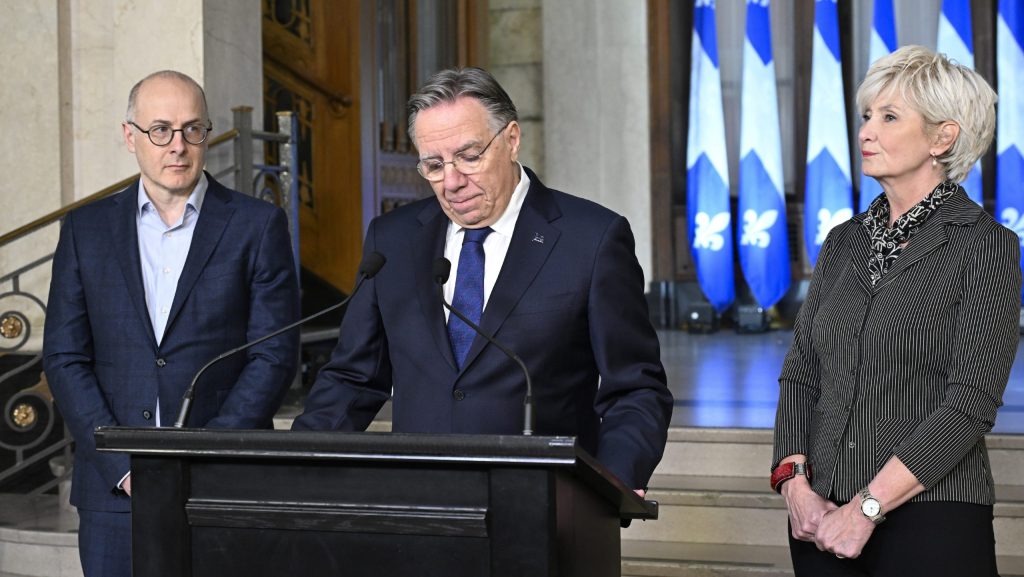
“I see well that right now Quebecers want change first, and among other things, a change of premier,” he said in his surprise resignation speech in Quebec City, flanked by his wife Isabelle Brais and his chief of staff Martin Koskinen.
The winner of an upcoming leadership race — the first in the party’s history since Legault founded the CAQ in 2011 — will become the next premier of Quebec.
The CAQ has long been third in the polls behind the Parti Québécois and the scandal-ridden Quebec Liberals. Legault said he hoped the Oct. 5 election would be focused on the big challenges facing Quebec, such as the economy and protecting the French language, rather than simply voting in a new party.
The decision to step down comes after a difficult year for Legault’s two-term majority CAQ. It was marked by a wave of high-profile departures, notably cabinet ministers Christian Dubé and Lionel Carmant; a ballooning deficit; botched projects like Northvolt; an uprising by doctors; and a cost overrun fiasco at Quebec’s auto insurance board.
Quebecers’ discontent with the CAQ manifested itself in two byelection losses last year – a total of four consecutive byelection defeats since the last general election – that showed the political momentum in the province was switching.
It’s a long fall from grace for Legault and the CAQ, which cruised to a majority government in 2018. That election victory marked the start of a new era in Quebec politics, ending nearly 50 years of Liberal and PQ rule.
Legault won an even bigger majority four years later. Buoyed by his popularity among francophones and his response during the COVID-19 pandemic — despite Quebec recording the highest death count in Canada as of 2024 — the 2022 election was called less than 10 minutes after the polls closed.
“I sincerely thank Quebecers for entrusting me with two majority mandates,” Legault said. “I deeply love Quebecers and Quebec, and being the premier of Quebec has been the greatest honour of my life.”
The Air Transat co-founder spent much of Wednesday’s lengthy press conference touting his party’s successes over his two mandates, as well as looking back on the accomplishment of forming his first majority government just seven years after founding the Coalition Avenir Québec.
During his time in office, his government tightened French-language rules for immigrants, businesses and public services, invoking the notwithstanding clause to overhaul the province’s language charter by passing Bill 96.
“Every day I woke up telling myself that a wanted the best for Quebecers,” Legault said. “I didn’t always succeed, but I can guarantee you that I tried very hard with all the energy I had.”
His government also pushed through Quebec’s secularism law, banning religious symbols for certain public servants, and later extending restrictions to prayer rooms in schools.
Those policies certainly played to his base. But it’s the turmoil of 2025 that ultimately led to his resignation.
“There were a lot of milestones during his mandate,” said political analyst Daniel Tran, the director in communications and governmental relations at Casacom. “We can think about the management during the COVID situation. He was very emotional, but also a lot of things to manage because we were in crisis.
“And then at the other side of those positive things, there were also some things that will stain his mandate. Of course we can think about what happened for example with the Northvolt situation. There’s a lot of things that he tried to do as a last resort during the last moments in his mandate. We think about the combat with the physicians for example, with the unions at the same time. So I think that was a Hail Mary at that moment to see if it sticks, if you could swing the electoral needle.”
Record deficit
The CAQ announced a record $13.6-billion deficit in March. Days later, credit agency Standard and Poor’s lowered the province’s credit rating for the first time in 30 years. A $46-million engineering contract relating to a controversial project to build a third span across the St. Lawrence River connecting Quebec City and its south shore was heavily criticized, as well as the millions of dollars in losses due to the failure of the Northvolt electric battery plant project.
SAAQclic fiasco
The Legault government suffered another blow in February when the province’s auditor general revealed cost overruns of at least half a billion dollars in the creation of the online platform SAAQclic. The botched 2023 rollout of the platform led to major delays and long lineups at insurance board branches. The scandal led to months of public hearings, during which Legault testified that he was kept in the dark about the cost overruns and laid most of the blame for the scandal on the leaders of the state-run corporation.
Doctors uprising
The adoption in October of a controversial law on physician remuneration led to widespread protests by doctors, some of whom publicly threatened to leave the province. The legislation, which tied part of physicians’ remuneration to performance targets and threatened steep fines for those who use pressure tactics to boycott the changes, also had opponents within Legault’s own party. The premier, who had promised not to back down on the legislation, got personally involved in the negotiations with family doctors. The result was a watered-down law that removed performance-related penalties in favour of a system of incentives. The dispute cost Legault’s party three legislature members, including two cabinet ministers. Junior health minister Carmant and MNA Isabelle Poulet quit the party in protest of the initial law, while Dubé resigned as health minister in the wake of the deal that weakened the legislation.
Wave of departures
Carmant, Poulet and Dubé weren’t the only legislature members to leave Legault’s party to sit as independents. In September, the premier expelled Pierre Dufour, the MNA for Abitibi-Est, from the CAQ caucus. In an interview with La Presse that month, Dufour had suggested he would resign and run for mayor of Val-d’Or if the premier did not appoint an elected official from the Abitibi-Témiscamingue region as a minister. That same month, Maïté Blanchette Vézina, who had recently been shuffled from cabinet, quit the party to sit as an independent, suggesting she’d lost faith in Legault and that his policies have neglected Quebec’s regions. In total, Legault’s party has lost 10 of its legislature members since the 2022 election.
Potential successors
Questions are mounting over who could take over from Legault and give the CAQ the best chance in the election.
The party’s board of directors is set to meet Wednesday night to begin that process.
Even before Legault announced he would step down, rumours swirled about potential successors. Those include Geneviève Guilbault, Simon Jolin-Barrette, Dubé, Sonia LeBel and Bernard Drainville.
“At this moment we have to be careful because it’s only speculation,” said Tran. “Internally we heard of, for example, Geneviève Guilbault who is minister municipal affair, who was also the minister of transport. We also heard other names, for example Simon Jolin-Barrette.
“However one name that keeps coming back in my analysis — it’s more of wishful thinking rather than a reality — is Mario Dumont. Mario Dumont was the founder of the ADQ before it became the CAQ. However he’s a newscaster, he’s in the news, he’s very present and he’s able to interview many people. From what I’m hearing internally, there’s not a chance for that, but people can put wishes, of course.”
What Montrealers had to say
CityNews spoke to several people on the streets of downtown Montreal Wednesday to get their reaction to Legault stepping down.
–“He read the room, he read the province. I couldn’t imagine him trying to do another election. … It’s not that I want to say I can’t think of anything positive, but I think he had a pretty tough mandate.”
–“His legacy is going to be his strict approach to the French language.”
–“It’s time. I think it will be better for English universities. I think we’re over him.”
–“He didn’t do anything. I don’t think he has a legacy.”
–“I’m an immigrant here. We’ve seen all the policies, all the controversies going on with that.”
–“He’s been through COVID as a first-time (premier), and I think that was a brave thing. But I think it’s his time.”
Opposition leaders, other politicians react
Marc Tanguay, interim leader of the Quebec Liberal Party: “There will come a time to take stock of his years in power, and Quebecers will have the final say on the legacy of his government. Today, I want to emphasize above all the immense responsibility of serving our nation as premier. It is a dedication that deserves our utmost respect.”
Paul St-Pierre Plamondon, leader of the Parti Québécois: “Despite our profound disagreements on the causes of our current collective difficulties and on the future of Quebec, François Legault has always been sincere in his desire to improve the lot of the Quebec nation. … He chose a different path, which likely had its limitations, but I want to acknowledge his commitment to moving Quebec forward and preserving its linguistic and cultural distinctiveness.”
Ruba Ghazal, Québec solidaire co-spokesperson: “Regardless of our political differences, I want to emphasize François Legault’s commitment to Quebec and the work he has accomplished over the years. We often disagreed during our discussions, but I wish him all the best for the future.”
Éric Duhaime, leader of Conservative Party of Quebec: “I believed in the François Legault of the Opposition who wanted to reduce the size of the government, put money back in taxpayers’ pockets, eliminate the deficit, increase private healthcare, develop our hydrocarbon resources, empower the regions, and defend Quebec autonomy. It’s clear, after more than seven years in power, that he has not achieved his objectives. … We can commend this public service of over 28 years and wish him a happy retirement.”
Montreal Mayor Soraya Martinez Ferrada: “Mr. Legault served Quebec at pivotal moments. We can think in particular of challenging times, notably the pandemic. He will have left a lasting mark on Quebec’s political life through decisions that will shape the province’s future. I truly wish him all the best going forward.”
Ontario Premier Doug Ford: “Thank you, Premier François Legault for your friendship, leadership and many years of public service, and for working so closely together to build a stronger relationship between the people of Ontario and Quebec. I wish you and your family all the very best in your retirement.”
Alberta Premier Danielle Smith: “I want to thank Premier François Legault for his years of dedicated public service to Quebec and to Canada. His leadership reflected a deep commitment to his province and to the well-being of the people of Quebec. It was a pleasure working alongside the premier at our Council of the Federation table. I wish him all the best in the next chapter and thank him for his contributions to our federation.”
–With files from The Canadian Press and Zachary Cheung, CityNews Montreal