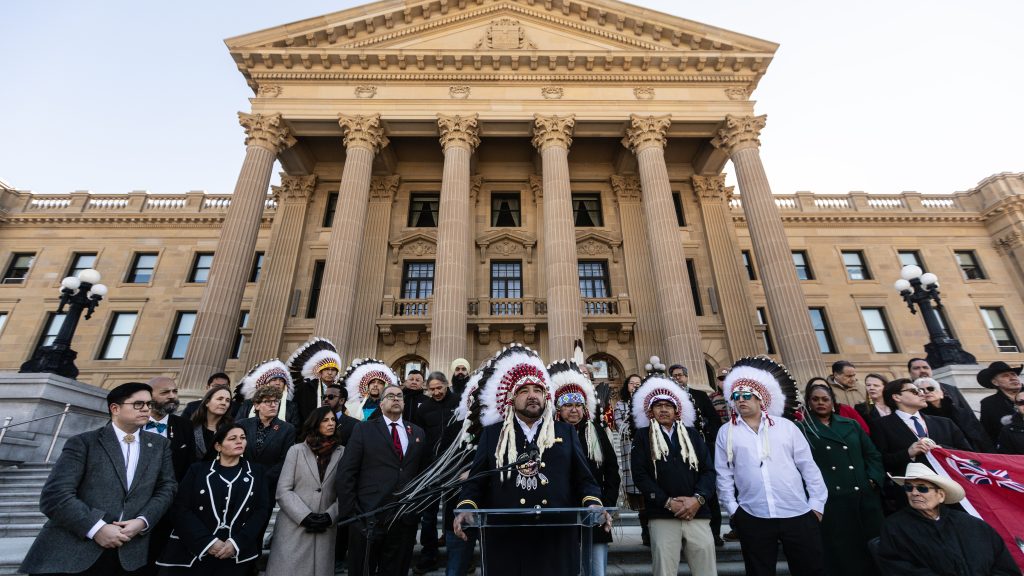
More than a dozen First Nations chiefs and even more band councillors and elders were at Alberta’s legislature Monday, calling on Premier Danielle Smith’s government to stomp out the push for the province to quit Canada.
“Our rights are being minimized,” Confederacy of Treaty 8 First Nations Grand Chief Trevor Mercredi told reporters.
“Our people are being minimized at every level.”
The comments came after First Nations chiefs across the province unanimously called on members of the legislature to hold a non-confidence vote against the government in part for how it has handled the budding separatist movement.
Opposition NDP Leader Naheed Nenshi tabled a motion to hold such a vote Monday, but it was promptly shut down by Smith’s majority United Conservative Party government.
Government house leader Joseph Schow called it a “political stunt” and questioned whether Nenshi believes in direct democracy.
“Who do you think you are … to say Albertans don’t have a right to have their voices heard?” Schow told the house.
Chiefs and other Indigenous leaders in the gallery voiced frustration before leaving, with some yelling at the politicians below to denounce separatism.
“Traitors!” shouted one.
Cold Lake First Nations Chief Kelsey Jacko said after the non-confidence vote that it was an attempt to “hold the premier to account.”
“No matter what we say, (Smith) doesn’t seem to hear us,” Jacko said outside the legislature.
“We have been trying to work with her and (her caucus) for years now. She keeps saying we have a great relationship. But how do you have a great relationship with someone who doesn’t listen?”
Mercredi said he knew the vote wouldn’t pass but that it was important to take a stand.
“We knew what (we were) in for when we came to this legislature,” he said.
“We’ve seen it time and time again — the disrespect that the MLAs have for our people in those rooms when they’re yawning, texting, leaning back on their chairs (and) smiling. It’s very unprofessional.”
Indigenous leaders have been vocally opposed to the separatist movement in Alberta. Multiple First Nations are challenging in court provincial legislation permitting citizen-led petitions that seek referendum votes, such as the ongoing campaign to put separation on a ballot.
While numerous Indigenous leaders were in Edmonton, others travelled to England, where a delegation from the Confederacy of Treaty Six First Nations is to meet with King Charles.
Grand Chief Joey Pete said in a news release he plans to discuss the separation push with the King and “remind (him) that our relationship is not with provinces or Canada — it is with the Crown.”
“Treaties are recognized in international law and any attempt to override them is a violation of the original agreements made between First Nations and the Crown,” the release said.
Pete was not available for an interview, and Buckingham Palace didn’t immediately respond to a request for comment.
Alberta Indigenous Relations Minister Rajan Sawhney called it a “tremendous opportunity” for the delegation to meet with the King.
“First Nation leaders have a right to engage with the Crown,” Sawhney said. “I think it’s totally fine that they’re doing so.”
Sawhney said she was hoping to meet with some of the leaders at the legislature and that she believed she was addressing their concerns about the separation movement.
“I do engage on a regular basis, and I always do affirm that the Constitution is the highest law in the land, and Section 35 rights (which protect treaty rights) are entrenched in the Constitution,” she said.
“There’s no legislation, policy or decision that will ever supersede that.”
Separation and what the NDP called a “fundamentally broken” relationship between Smith’s UCP and First Nations dominated question period.
Nearly a dozen chiefs, many wearing ceremonial headdresses, watched in the gallery. At times, chiefs and other Indigenous leaders cheered and clapped for NDP questions, especially when Nenshi accused the premier of undoing treaty rights “step by step.”
Nenshi also accused Smith of ignoring the chief’s declaration of non-confidence in her government and pandering to both sides of the separatism debate.
Smith and her ministers said the government is trying to renegotiate its relationship with Ottawa and continue building on its connections with First Nations leaders, and that the Constitution is the “highest law of the land.”
“Sovereignty is not the same as separation,” Smith said.
Smith, asked how she would make a separatist petition constitutional, said it’s not her petition.
“We’re addressing the real grievances that Alberta has with the 10 years of mistreatment by Ottawa,” Smith said.
Meanwhile, the Calgary Chamber of Commerce released a report indicating 51 per cent of Calgary respondents believe the current separatism debate is affecting the provincial economy, with 93 per cent of those believing the impact is negative.