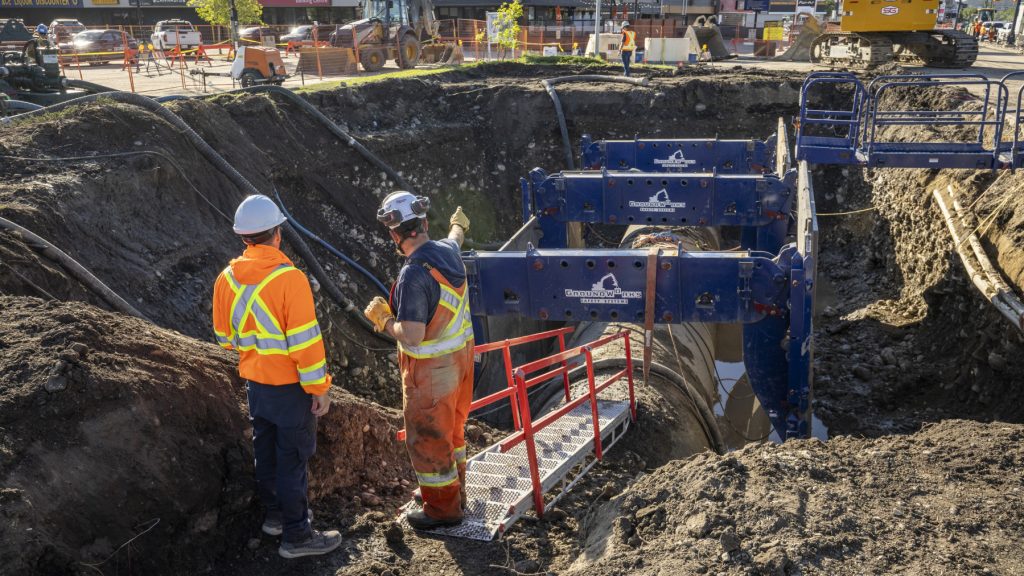
The chair of an independent panel examining the 2024 failure of Calgary’s Bearspaw Feedermain says a poor management structure and less than robust risk and asset management planning are to blame for the city’s water woes.
Siegfried Kiefer, a former ATCO executive who was tapped to lead the panel of five industry experts said Wednesday the blame can’t be laid at the foot of one individual or council, but on governance.
“I believe you would have averted having this situation of water curtailment,” he said. “There were several opportunities over the last couple decades to build in resiliency and redundancy associated with that Bearspaw Feedermain.”
Two such opportunities were the completion of the North Feedermain Enhancement Project and the South Feedermain Enhancement Project, Kiefer says. But, both were deferred until recently.
“Both of those could’ve been actioned much sooner than we are dealing with now and had they been, you would’ve been able to divert flows around this rupture and not interrupt service to Calgarians,” he added.
Kiefer explains the panel found a 2004 report following a break in the pipe at McKnight Boulevard, warning of corrosion on the Bearspaw Feedermain compromising its integrity.
“You can see from the post-incident reporting that was done at that time that the city was alerted to the fact that this vintage of pipe had issues around corrosion and failure as a result of the soil chemistry surrounding the pipe and it managing to penetrate the concrete barriers to actually embrittle the coil wrapping the pipe,” Kiefer explained.
Calgary’s management structure isn’t set up to allow for escalation to the proper level, Kiefer said, adding that the city is an anomaly when it comes to its approach to water management.
“Most cities would have a head of their water utility,” he explained.
A result of this is also a lack of investment in key areas of the water system.
The panel is recommending water move to a formal corporate structure that is owned by the city, similar to how electricity is governed under ENMAX.
Siegfried is also calling for the creation of a dedicated water utility department with a single accountable executive and transparent financial reporting.
It is also a recommendation of the panel and a conversation among council what can be done to speed up the full replacement of the pipe.
Both Siegfried and city officials say that is the only way to ensure stability and limit additional breaks.
Reacting to the report, new mayor Jeromy Farkas says he doesn’ want to lay blame on anyone specific.
“I just want to focus on what we can do to get ourselves out of the current situation,” he says. “We are going to learn from the mistakes that were made 20 years ago, but we are going to action that to make sure that our water system remains in service for the next 100 years.”
Farkas says council is committed to acting on the report’s recommendations.
“I’m really pleased that this report has been made public, it’s the good, the bad, and the ugly,” he says. “Everything that council needs to do to ensure that council’s drinking water stays safe.”
The chair and fellow industry experts were called on by former Mayor Jyoti Gondek following the break on June 5, 2024 when water began flowing onto 16 Avenue NW in Montgomery, covering the Trans Canada Highway and neighbouring Shoudice Park.
What followed was a state of local emergency, weeks of Stage 4 water restrictions, dozens of repairs, and a call for answers.
Concern surrounding the integrity of the pipe, which carries water to 60 per cent of Calgarians was reignited last week after another break on the Bearspaw east of the Sarcee Trail and 16 Avenue NW interchange.
The city remains under Stage 4 water restrictions as a result.