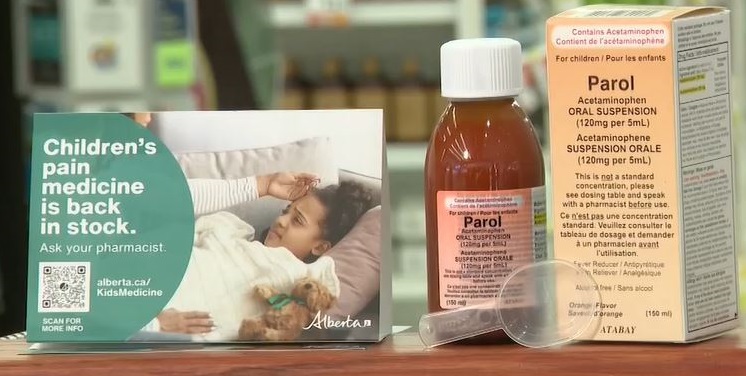
About half of the bottles of children’s medication imported into Alberta in 2023 have been destroyed after attempts to donate them to other countries failed, says Alberta Health Services (AHS).
The 1.4 million bottles — a quarter of the five million requested in 2022 — came with a $70 million price tag, which the province received from Turkey-based Atabay Pharmaceuticals in 2023. The request was made following a countrywide shortage of acetaminophen and ibuprofen.
After receiving those bottles, AHS reached an agreement with Health Partners International of Canada (HPIC) in mid-2025 to donate the remaining supply of imported children’s pain and fever medication to countries in need.
However, only half were donated, and with an early 2026 expiration, the rest, around 700,000, were disposed of at the Swan Hills Treatment Centre at a cost of around $718,000, AHS confirmed with 660 NewsRadio after an initial report from The Globe and Mail.
“HPIC (Health Partners International) identified challenges to donate the remaining half of the medication, with the main constraints being the expiry date of the medicine for early 2026, and logistical challenges getting the medicine to countries in need,” said AHS spokesperson Kristi Bland.
“After exhausting all avenues to donate the remaining medicine, the remaining medication that was not donated was disposed of. While disposal of expired medication is not out of the ordinary, AHS has plans in place to limit the amount of disposal to reduce waste as much as possible.”
She says between 2023 and 2025, storage costs reached $478,000.
Alberta Premier Danielle Smith’s United Conservative government has long stood by its decision to import the medication during the countrywide shortage of acetaminophen and ibuprofen.
Longtime health policy analyst Stephen Lewis says he is baffled by the decision-making involved and questions the size of the purchase based on how quickly the drugs would expire.
“Why did they buy this much? Why didn’t they buy less? How come so little was used? I mean, it just seemed to be a combination of very sloppy processes, rapid decision-making,” he tells 660 NewsRadio.
“A lot of product — everybody knows there’s an expiry date. As you get within a year of it or six months of it, surely there should be a plan for what to do about it to make sure that somebody benefits.”
The Alberta NDP is calling for a public inquiry, which some believe is a $70 million fiasco, the cost of which has grown again.
“The pattern that we’ve seen with other really quite expensive failures like the failed lab privatization, which cost taxpayers over $100 million, and the government had to backtrack on … is poor decisions,” said political economist Andrew Longhurst with the Centre for Policy Alternatives.
Last fall, an independent review by retired Manitoba judge Raymond Wyant found AHS decision makers failed to follow proper procedures, but he says he was unable to make an absolute determination on whether government officials committed wrongdoing.
Because the investigation wasn’t a public inquiry, he couldn’t compel records or subpoena witnesses to testify under oath. He didn’t interview Smith, her current chief of staff, or any of her ministers. However, Smith also said she expected all government staff and ministers to cooperate with Wyant’s investigation.
Meanwhile, Alberta’s Auditor General, who didn’t want to comment, continues to investigate.
The RCMP is looking into allegations of conflict of interest.
With files from The Canadian Press