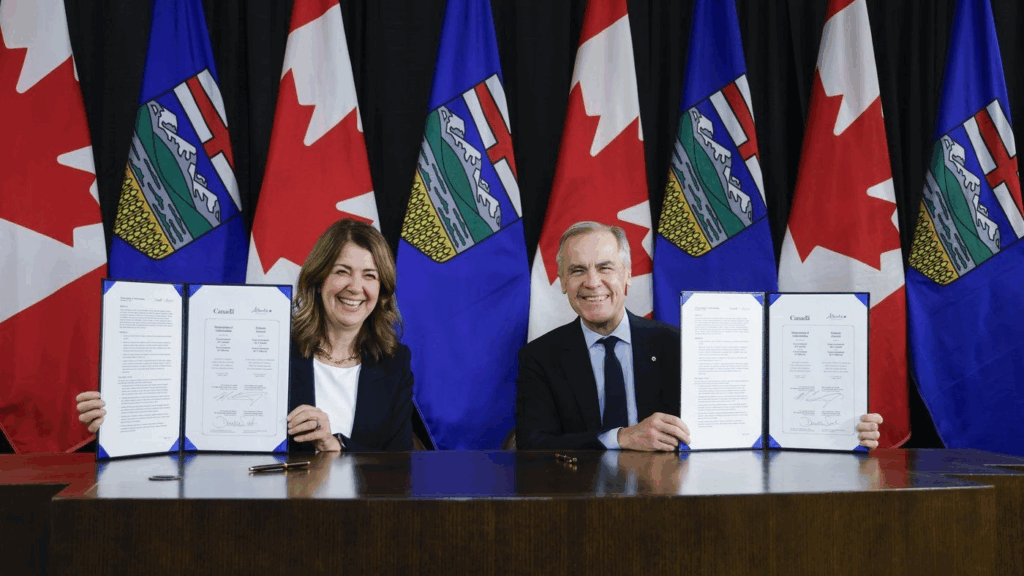
A carbon pricing deal is likely to be announced on Friday between Alberta and Ottawa, according to sources, with the cost for emitters reportedly being set at $130 per tonne by 2040.
Last week, Alberta Premier Danielle Smith was in Ottawa, where she met with Prime Minister Mark Carney on Parliament Hill to discuss the bitumen pipeline to the West Coast. They both emerged from that meeting sounding very positive that a deal would be signed soon.
The agreement would put in place some of the terms of the memo of understanding (MOU) they struck last November. The MOU is a commitment to shared values and principles that will govern a future agreement.
Sources familiar with the discussions of this phase of the MOU are calling it a significant agreement, given Alberta’s historic carbon pricing policy, which Premier Danielle Smith previously froze at $95 per tonne just one year ago.
They note it is six-and-a-half times the effective trading price before the MOU was signed.
This agreement will include escalating price floors to ensure Canada’s heavy emitters have continued incentives to reduce their emissions footprint each year. The headline price on carbon in Alberta would be $100 per tonne in 2027, rising to $130 per tonne in 2035 and escalating 1.5 per cent per year starting in 2036.
The agreement includes stringency rate benchmarks.
Eleanor Olszewski, the minister of Prairies Economic Development Canada, confirmed Wednesday at a housing announcement in Alberta that Carney is coming to Calgary on Friday.
While no official announcements have been made, there are two key issues that must be resolved.
First is reaching that agreement on the industrial price of carbon on big emitters. Carney scrapped the consumer carbon tax last year shortly after he became prime minister, but he left the industrial carbon tax in place.
That figure was headed towards the level of $170 per tonne of carbon emitted by 2030, under the previous Liberal government.
Alberta Premier Smith said last week that $130 per tonne price was much more realistic. At $170, she says, there’s a real discouragement to further development in the energy sector.
There’s also a requirement that big energy companies participate in a massive carbon capture and storage project called Pathways. The idea is to reduce the amount of emissions. It’s estimated to cost about $20 billion.
Reducing the per-barrel emissions of carbon that come out of the oil sands is a key condition that Carney has insisted be included in any agreement to build a pipeline.
Alberta and Ottawa have been negotiating an energy and environment pact to overcome long-standing disagreements between the two governments about oil and gas production and climate regulations.
Now, even if Alberta and Ottawa reach an agreement on those two points, there could still be many steps before shovels are in the ground for what Carney considers to be one of his nation-building projects.
Both sides need to commit to a route for the proposed pipeline. Does it go to B.C.’s northwest coast, where there’s a federal tanker ban in place and a lot more consultation required with Indigenous groups?
Or does it go south along the existing Trans Mountain pipeline route that terminates in Burnaby, B.C., close to Vancouver? That would mean a lot more tanker traffic just off Vancouver’s coast, which could be controversial as well.
Both plans would require considerable consultation with Indigenous groups, and it’s expected they would take an ownership position in a new pipeline.
The original deadline to complete the conditions laid out in the memorandum of understanding was April 1. That deadline has since been moved to July 1.
Carney is scheduled to meet with his cabinet Wednesday, where it’s expected they will discuss the potential agreement. He won’t face much resistance, of course, from any of his ministers.
But the reaction from environmentalists will be a lot less friendly. They will push back against the plan to extract more oil and continue to question the prime minister’s commitment to fighting climate change.