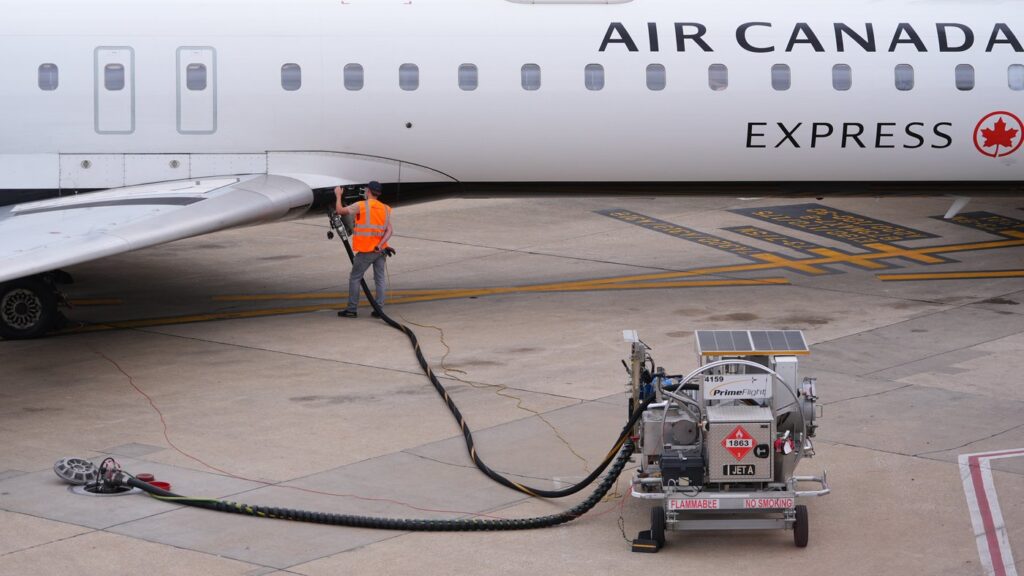
Skyrocketing jet fuel costs threaten to push airfares up and flight numbers down well into the peak summer travel season, even as signs of hope emerge that oil flows from the Persian Gulf are set to resume.
Iran’s foreign minister said Friday the Strait of Hormuz was “completely open” for all commercial ships after a ceasefire deal between Israel and Lebanon, though uncertainty remains amid an ongoing American blockade of Iranian ports.
Even if the agreement sticks, experts say it will take weeks for oil traffic to ramp up, while jet fuel could take much longer to reach prewar production levels given the damage to refineries in the Middle East.
The energy crisis set off by the Iran war and the effective seven-week closure of the strait means Canadian airlines have already begun to bake soaring costs into their prices and will continue to for at least several months, said independent aviation analyst Rick Erickson.
“The prices will go up,” he said.
“Over the summer of 2026 … there will not be any deals,” he said. “And believe me you’re going to have to pay.”
Canada’s major carriers have raised gross fares and tacked on fuel surcharges of between $25 and $60 per ticket for some flights. Air Canada announced higher baggage fees this week — to $45 from $35 for the first checked bag in its basic economy class on domestic, U.S. and sun destination flights, for example.
The airline also confirmed plans to suspend flights to New York City’s JFK airport from Toronto and Montreal between June 1 and Oct. 25.
“Jet fuel prices have doubled since the start of the Iran conflict and some lower profitability routes and flights are no longer economic, and we are making schedule adjustments accordingly,” said Air Canada spokesman Christophe Hennebelle in an email Friday.
He said the carrier will continue to fly to New York-area airports 34 times daily — down from 38 — from six cities across Canada. The thousands of affected customers will be contacted with alternative travel options, the company said.
The slimmed-down flight network underscores how airlines project that even the apparent opening of the strait on Friday will fail to tamp down jet fuel prices through much of the spring and summer.
Carriers across the globe have had to trim their flight schedules as ballooning fuel costs render some routes unprofitable.
Lufthansa — an Air Canada partner via the Star Alliance global airline network — said Thursday it will gradually cut flight volumes on its mainline service and ground 27 planes from its CityLine subsidiary starting Saturday. KLM announced it will cancel 160 European flights to and from Amsterdam’s main airport in the coming month. Numerous airlines in Asia and the Middle East have also slashed capacity.
North American carriers draw largely from refineries in Canada and the U.S. and remain more insulated from the fuel shortages than Gulf-dependent Asia and Europe, but they may find connecting options more limited as airlines abroad cut less lucrative trips and ground less efficient planes. Typically, the Middle East supplies three-quarters of Europe’s net imports of jet fuel, according to the International Energy Agency.
It said Thursday that several European countries may start to face jet fuel shortages within six weeks.
Canada remains better positioned, with more than a half-dozen refineries in the country churning out kerosene-based aircraft fuel. More than four-fifths of the jet fuel consumed in Canada is produced domestically, according to John Gradek, who teaches aviation management at McGill University.
“Why are we paying Middle East pricing for fuel if we are self-sufficient in fuel? The answer is the same as when we talk about gasoline for your car: our pricing models are based on the world price,” he said.
“This is the worst situation we’ve seen with aviation fuel in history.”
Air Canada spokesman Peter Fitzpatrick said the airline sees “no imminent supply issues.”
WestJet said it has made no change to its flight network — so far.
“However, we are evaluating our summer schedule and may adjust flying to balance fuel supply,” said spokeswoman Julia Kaiser.
Gradek said that even if damage to Gulf refineries is less than suspected, facility repairs, production ramp-ups and long transport times mean higher prices will “be here for a while” due to a narrower stream of oil and jet fuel.
The inflated fares will linger longer still if ships hold back on braving passage through a waterway where Iranian vessels and ports continue to be sealed off under an American blockade, which U.S. President Donald Trump said Friday “will remain in full force” until the White House reaches a longer-term deal with Tehran.
Some consumers may be second-guessing a planned trip overseas given the higher price tags and chance of trip disruption, but generally the urge to travel remains strong.
“Consumer air travel demand appears mostly stable in the face of global uncertainty and rising fuel costs (and) airfares,” according to a Stifel consumer survey this week.
For airlines, the conflict has also opened up rare opportunities. Air Canada ramped up its Toronto-Delhi service to twice daily and deployed larger planes on some Toronto-London-Mumbai flights last month as Middle Eastern airlines scaled back.
“This is a worldwide event,” said Erickson. “You can bet they’re using all their little tricks.”