An Edmonton man who supplied a semi-automatic rifle later used to kill two police officers has been found guilty of manslaughter.
Dennis Okeymow sat still next to his lawyer, his hands in his lap, as he was convicted Tuesday on three counts of manslaughter along with a number of lesser charges in Court of King’s Bench.
Justice John Little said while Okeymow didn’t pull the trigger, by selling a semi-automatic rifle to 16-year-old Roman Shewchuk, the man knew or should have known something terrible could result.
Little noted there was “no intervening act to break the chain of causation” between the selling of the weapon and the deaths.
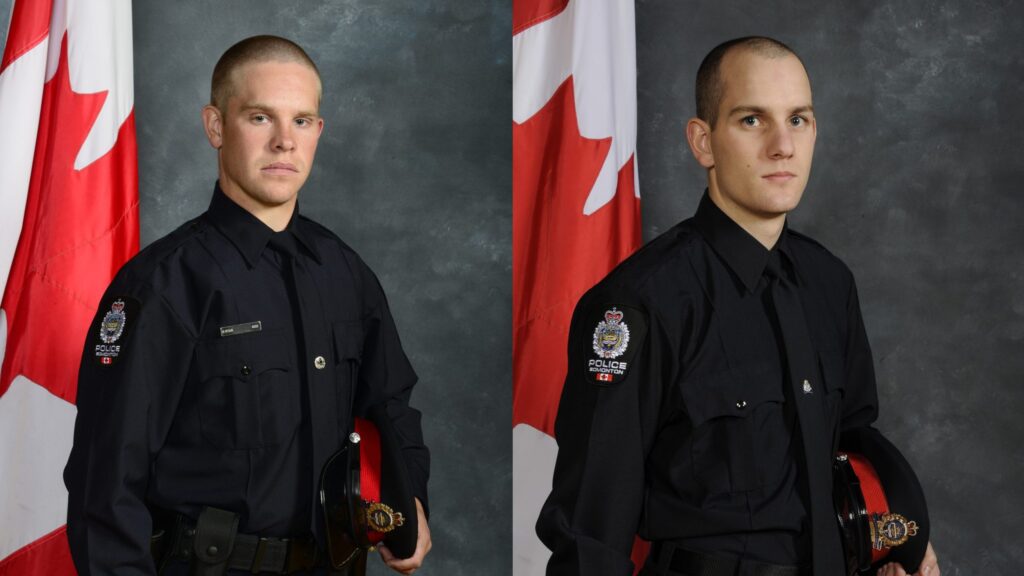
Okeymow was charged in the 2023 deaths of Edmonton police constables Travis Jordan and Brett Ryan, as well as the teen.
The officers were responding to a domestic disturbance at an apartment building when they were ambushed and shot to death by Shewchuk.
Shewchuk then killed himself.
The Crown prosecutor had argued for the manslaughter verdicts, telling Little there must be accountability for selling a weapon to a minor knowing some harm could result.
Okeymow’s lawyer argued his client was being scapegoated for a tragedy despite not being directly responsible for the deaths.
Okeymow was convicted Tuesday of 10 charges. He had earlier plead guilt to seven others. The manslaughter verdicts pertain to the two officers and to Shewchuk.
He was also convicted of criminal negligence causing bodily harm relating to Shewchuk using the weapon to shoot a man in a pizza shop in the days leading up to the officers’ deaths.
At trial, court heard Okeymow sold the .22-calibre semi-automatic rifle and 80 rounds of ammunition to Shewchuk just weeks before the tragedy. The teen initially asked for a handgun, but Okeymow said he didn’t have one.
Shewchuk bought the rifle for $2,500.
The events of the fateful night began, court heard, when Shewchuk strangled his mother until she lost consciousness. When she woke up, she ran to a nearby apartment building where she called police.
Jordan and Ryan responded and were gunned down by the teen as they stood outside the family’s apartment. The teen’s mother was also shot but survived. Shewchuk then turned the gun on himself.
During earlier arguments, Okeymow’s lawyer, Jamil Sawani, stressed that his client was shouldering an unfair burden of blame.
“(Okeymow) is, frankly, an easy scapegoat in our society upon which to heap the responsibility of these tremendous sorrows, when there is no other concrete person to blame for this tragedy,” Sawani told court during closing arguments on April 30.
Crown prosecutor Adam Garrett argued that Okeymow should be held criminally responsible for selling the gun. Garrett said the sale was aggravated by the fact Okeymow also sold Shewchuk cannabis and cocaine. Shewchuk had earlier been hospitalized for schizophrenia.
Court heard Shewchuk and Okeymow exchanged more than 600 text messages, most related to drugs, and met up two dozen times.
Garrett said the case is among the few in Canada in which someone who sells a gun for monetary gain faces homicide-related charges but that Little could apply existing laws around liability.
“The accused knew or was wilfully blind that the rifle was not needed for any legitimate purpose,” Garrett said on April 30.
“Roman’s purpose was obviously illegitimate and dangerous.”