The flurries forecasted for Halifax today pale in comparison to the freak snowstorm 108 years ago that dumped approximately 40 cm of snow on the rubble caused by the Halifax Explosion.
A hundred years ago meteorologists relied solely on ground observation — no satellites existed to help track weather patterns — so when a low pressure area crossed Florida and moved northward from the Gulf of Mexico into the Atlantic Ocean, the perfect conditions for a nor’easter developed. And no one knew.
Historian Blair Beed said on the Todd Veinotte Show that the weather conditions contributed to the death toll, and that people who may have survived, ultimately froze to death.
But it wasn’t the weather conditions that caused the travesty. The thick blanket of snow fell a day later. On the morning of the explosion it was a blissful 4 C, according to Environment Canada historical weather data.
The explosion occurred when the French cargo ship SS Mont-Blanc collided with the Norwegian SS Imo in the Halifax Harbour.
While Beed said historians are still not conclusive on what caused the initial spark — perhaps the rattling of a stove on board or the grinding of metal on metal — once that first spark lighted, there was no hope.
“It was a floating bomb,” Beed said of the Mont-Blanc which was carrying a full load of explosives at the time. During wartime there were a number of vessels in and out of the harbour, and the crash was simply caused by human error, he said.
“It was like a highway. It was like rush hour traffic because it was wartime.”
The explosion decimated approximately a 1.6 km radio, flattening homes and businesses within the municipality.
Over 1,000 people were killed instantly, but the death toll only grew as time went on. Beed said he’s seen obituaries from over five years later that claimed the person died of injuries incurred at the time of the explosion.
And for those who did survive, they are forever haunted by their injuries.
“People became bedridden and never got up again,” Beed said, noting the injuries were long lasting. “When I was growing up as a kid you would see people with the scars in their faces from the flying class and debris.”
The municipality banded together to provide relief efforts, sheltering people in church halls, theatres and hallway buildings, Beed said.
People were then moved into temporary housing which led to the creation of the Hydrostone neighbourhood.
It was simply some regular citizen who became local heroes.
One citizen ran along the train tracks to get the word out, which made its way to the Governor of Massachusetts who immediately sent aid. Each year, Nova Scotia sends its thanks in the form of a Christmas tree that is lit up in the Boston Commons.
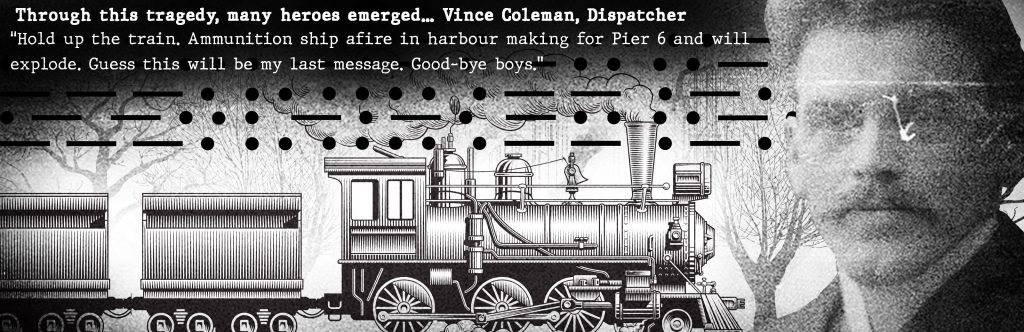
Other local heroes include Vince Coleman, a train dispatcher who stopped an overnight passenger train from arriving in Halifax on the morning of the explosion, and Dr. Clement Ligoure, who treated patients for free in his clinic.
Coleman and Ligoure are being commemorated in a special lights show running Saturday rom 5 p.m. to 11 p.m. The show is part of the Delightful Downtown initiative which sees light shows at Grafton Park lighting up the darkness all winter.